
Written by Black Car Premium Team
Published: November 9, 2026
Read Time: 16 minutes
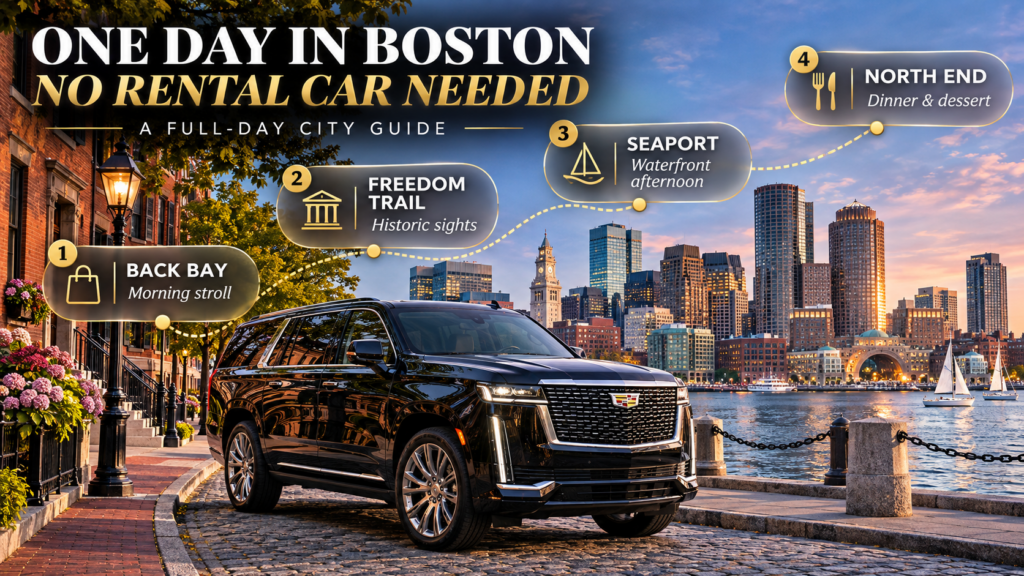
You do not need a rental car to see Boston.
In fact, for many visitors, renting one can make a day in central Boston more complicated.
Boston’s most popular neighborhoods and attractions are concentrated across a relatively compact area, and many trips can be completed using a combination of:
- Walking
- MBTA subway
- Commuter rail
- Ferry
- Taxi or rideshare
- Point-to-point transportation
- Hourly private transportation
The important part is planning the day geographically.
A good Boston itinerary might move:
Boston Common → North End → Waterfront
because those destinations fit together naturally.
A poor itinerary might jump:
Harvard → Seaport → Fenway → North End → Cambridge
simply because those attractions all appeared on a list of things to see.
The goal is not to fit the greatest number of Boston landmarks into one day.
It is to spend more time experiencing Boston and less time traveling between places.
This guide explains how to plan a full Boston day without renting a car—and when walking, public transit, a direct ride, or an hourly chauffeur makes the most sense.
Quick Answer: Do You Need a Rental Car in Boston?
For a trip concentrated in central Boston and Cambridge, usually not.
A rental car becomes more useful when you plan to visit destinations farther outside the city, such as:
- Lexington and Concord
- Suburban business campuses
- Multiple Greater Boston towns
- Cape Cod
- Rural New England destinations
For central Boston sightseeing, a car also creates additional considerations:
- Parking
- Garage fees
- One-way streets
- Traffic
- Moving the vehicle between attractions
- Hotel parking
For many visitors, the better strategy is to choose transportation separately for each part of the day.
The Golden Rule: Group Boston by Neighborhood
Boston becomes much easier when you stop thinking about individual attractions and start thinking about geographic clusters.
Historic Boston Cluster
- Boston Common
- Massachusetts State House
- Freedom Trail
- Faneuil Hall
- North End
- Waterfront
Back Bay / Fenway Cluster
- Boston Public Library
- Copley Square
- Newbury Street
- Prudential area
- Fenway Park
- Museum of Fine Arts
- Isabella Stewart Gardner Museum
Cambridge Cluster
- Harvard Square
- Harvard University
- MIT
- Kendall Square
Seaport Cluster
- Harborwalk
- Seaport restaurants
- Institute of Contemporary Art area
- Waterfront
- Convention district
Keeping destinations together can eliminate several unnecessary vehicle trips.
Before You Choose Transportation, Choose the Day
There are several very different ways to spend one day in Boston.
A first-time visitor interested in history should not follow the same itinerary as a family visiting museums.
Someone interested in Harvard and MIT should not spend half the morning traveling toward Fenway.
Below are four realistic ways to organize a Boston day.
Itinerary 1: Classic First-Time Boston
This is the strongest choice for someone visiting Boston for the first time.
The focus is:
Boston Common → Freedom Trail → Faneuil Hall → North End → Waterfront
Most of this day can be completed on foot.
9:00 AM — Start at Boston Common
Boston Common is the natural starting point for the Freedom Trail.
Spend some time around:
- Boston Common
- Public Garden if desired
- Massachusetts State House area
Wear comfortable shoes.
A full historic Boston day involves significant walking.
9:30 AM — Begin the Freedom Trail
Follow the Freedom Trail through Downtown Boston.
Potential stops include:
- Massachusetts State House
- Park Street Church
- Granary Burying Ground
- King’s Chapel
- Old South Meeting House
- Old State House
You do not need to spend equal time at every stop.
Choose the places that genuinely interest you.
11:30 AM — Faneuil Hall Area
Continue toward Faneuil Hall.
This is a good place to:
- Take a break
- Explore the surrounding marketplace
- Decide whether to continue directly into the North End
Avoid making the day so rigid that every stop has an exact minute attached.
Boston is better explored with some flexibility.
12:30 PM — Lunch in the North End
The North End is within easy reach of the historic core.
This is one of the main advantages of planning geographically.
You are not arranging another ride just to eat lunch.
Walk into the neighborhood and choose:
- Italian restaurant
- Pizza
- Café
- Bakery
Then continue exploring nearby historic streets.
2:00 PM — Explore the North End
Potential stops include:
- Paul Revere House
- Old North Church
- Hanover Street
- Waterfront edges of the neighborhood
Again, choose based on your interests.
You do not need to check every landmark off a list.
4:00 PM — Waterfront
Finish the afternoon around:
- Long Wharf
- Harborwalk
- Waterfront
- Aquarium area
This provides a completely different atmosphere from the historic streets earlier in the day without requiring a long transfer.
6:00 PM — Dinner
You can stay around:
- North End
- Waterfront
- Downtown
There is little reason to travel across the entire city for dinner unless you have a specific reservation elsewhere.
Best Transportation for This Day
Walking: Excellent
MBTA: Optional
Rental car: Unnecessary
Private transportation: Mainly useful for hotel pickup/drop-off or evening plans
This itinerary is a good example of a day where hourly transportation would probably be unnecessary.
That matters.
Use hourly service only when the schedule benefits from it.
Itinerary 2: Back Bay, Museums & Fenway
This day is better for visitors who prefer:
- Architecture
- Shopping
- Art
- Fenway
- Back Bay
9:00 AM — Copley Square
Start around Copley Square.
Explore:
- Boston Public Library
- Trinity Church area
- Back Bay architecture
The Boston Public Library alone can justify a meaningful stop rather than a quick photograph.
10:30 AM — Newbury Street
Walk through Back Bay toward Newbury Street.
You can stop for:
- Coffee
- Shopping
- Architecture
- Galleries
This part of the day requires no vehicle.
12:00 PM — Lunch
Stay in Back Bay or continue toward the Fenway area.
Again, avoid unnecessary cross-city travel.
1:30 PM — Choose One Museum
Pick either:
- Museum of Fine Arts
- Isabella Stewart Gardner Museum
Trying to fully visit both in one afternoon can make the day feel rushed.
Choose one and enjoy it properly.
4:30 PM — Fenway Area
After the museum, explore:
- Fenway neighborhood
- Fenway Park area
- Nearby restaurants
If there is a Red Sox game, the atmosphere changes significantly.
Plan additional time for crowds and event traffic.
6:30 PM — Dinner or Game
You can finish with:
- Dinner near Fenway
- Red Sox game
- Return to Back Bay
Best Transportation for This Day
Walking: Excellent between Back Bay attractions
MBTA: Helpful for longer segments
Rental car: Usually unnecessary
Private transportation: Useful if dinner/event timing is fixed or weather is poor
This is still primarily a walking/transit itinerary.
Itinerary 3: Harvard, MIT & Cambridge
Cambridge deserves its own day rather than being squeezed between unrelated Boston attractions.
A logical route is:
Harvard Square → Harvard → Kendall Square → MIT
9:00 AM — Harvard Square
Start the morning around Harvard Square.
Explore:
- Harvard Yard
- Surrounding streets
- Harvard Square shops and cafés
Allow time to experience the neighborhood rather than simply photographing a gate.
11:30 AM — Lunch in Cambridge
Stay in Cambridge.
This prevents unnecessary movement back into Boston only to return later.
1:00 PM — Head Toward MIT/Kendall Square
Travel from Harvard toward the Kendall/MIT area.
Public transit can work well for this movement.
1:30 PM — MIT
Explore the MIT campus area.
Depending on your interests, spend time around:
- Campus architecture
- Charles River
- Kendall Square
4:00 PM — Kendall Square
Kendall Square offers a different feel from Harvard Square.
This area is particularly interesting for visitors interested in:
- Technology
- Biotechnology
- Research
- Innovation
6:00 PM — Dinner
Either remain in Cambridge or return into Boston.
Best Transportation for This Day
Walking: Good within each area
MBTA: Excellent between major Cambridge points
Rental car: Generally unnecessary
Private transportation: Useful for families, groups, weather, or travelers combining Cambridge with several Boston stops
Itinerary 4: The Multi-Neighborhood Boston Day
This is where transportation becomes more important.
Suppose your wish list includes:
- Boston Common
- Harvard
- Fenway
- Seaport
- North End dinner
These destinations do not form one compact walking route.
Now your day may look like:
Hotel → Boston Common → Harvard → Fenway → Seaport → North End → Hotel
That is a completely different transportation problem.
Why This Day Is Harder
You are moving between:
- Downtown Boston
- Cambridge
- Fenway
- Seaport
- North End
Walking alone will not solve the itinerary.
Public transportation can still work, but you will need:
- Several routes
- Transfers
- Walking between stations
- More schedule awareness
Rideshare can work too, but you may arrange several separate vehicles.
This is the type of day where hourly chauffeur service in Boston can become practical because the vehicle remains connected to a multi-stop itinerary.
Example Full-Day Multi-Stop Schedule
8:30 AM — Hotel pickup
9:00 AM — Boston Common
10:30 AM — Cambridge / Harvard
12:30 PM — Lunch
2:00 PM — Fenway
4:00 PM — Seaport
6:30 PM — North End dinner
8:30 PM — Hotel
Would I recommend adding even more stops?
No.
That is already a full day.
Why More Stops Do Not Mean a Better Trip
This is one of the biggest mistakes visitors make.
A schedule like:
Harvard → MIT → Fenway → MFA → Boston Common → North End → Seaport → TD Garden
may technically be possible.
But the traveler spends much of the day:
- Walking to transportation
- Waiting
- Driving
- Looking at the clock
A good itinerary should allow time to actually experience each area.
When Walking Is Best
Walking is ideal when:
- Destinations are nearby
- Weather is comfortable
- Travelers are physically comfortable
- Luggage is minimal
- Schedule is flexible
Boston’s historic core particularly rewards walking.
Many attractions were never designed around automobile travel in the first place.
When the MBTA Is Best
Public transportation is useful when:
- Stops are near stations
- Schedule has flexibility
- Traveler is comfortable navigating transit
- Group is relatively small
Strong transit use cases include:
- Downtown → Harvard
- Back Bay → Downtown
- Downtown → Cambridge
- Boston → Fenway-area destinations
Always check current service conditions before relying on a specific route.
When Rideshare or Taxi Makes Sense
Rideshare and taxis are useful for:
- Occasional cross-city trips
- Casual schedules
- Small groups
- Situations where you do not need a reserved vehicle all day
Example:
Museum → Restaurant
You may not need anything more complicated.
When Point-to-Point Transportation Makes Sense
A scheduled direct car works best when the traveler has:
One confirmed pickup + one confirmed destination.
Examples:
Hotel → Museum
Restaurant → Event
Hotel → Logan
If the day only requires one or two important transfers, point-to-point transportation may be sufficient.
When Hourly Transportation Makes Sense
Hourly transportation becomes useful when three things happen:
1. Several Stops
The day keeps moving.
2. Timing May Change
Lunch runs long.
Museum visit takes less time.
Meeting ends early.
3. You Want One Transportation Plan
Rather than arranging another ride after every stop.
This is especially practical for:
- Families
- Senior travelers
- Executives
- Client entertainment
- Shopping
- Several appointments
- Real estate visits
- Travelers with limited time in Boston
Hourly Does Not Mean Staying in the Vehicle All Day
This is an important distinction.
You may spend:
- Two hours inside a museum
- An hour at lunch
- Time walking around Harvard
- Time exploring the North End
The vehicle is simply part of the transportation structure between those activities.
The purpose is not to drive past Boston through a window.
Best Boston Day for Families
Families should build fewer stops than adult-only groups.
A reasonable day might be:
Boston Common → Public Garden → Lunch → Museum of Science → Dinner
or:
Aquarium → Waterfront → Faneuil Hall → North End
Factors to consider:
- Children tire faster
- Bathroom breaks
- Food
- Strollers
- Weather
- Transit stairs/elevators
- Car seats
The best family itinerary is rarely the longest one.
Boston Without a Car for Older Travelers
Older travelers may want to reduce walking.
Boston is walkable—but that does not mean everyone needs to walk five miles.
A good schedule might combine:
- Short walks
- Direct vehicle transfers
- Longer stops at attractions
Hourly transportation can be useful when mobility and comfort matter more than maximizing transit use.
Boston Without a Car During Winter
Winter changes the transportation equation.
Snow and ice can make:
- Walking slower
- Sidewalks difficult
- Transit less comfortable
- Waiting outdoors unpleasant
A summer itinerary built around several miles of walking may need to change in January.
Always plan based on the actual season.
Boston Without a Car During Heavy Rain
Same principle.
On a clear day:
Copley → Newbury Street
is an enjoyable walk.
During heavy rain in formal clothing, that may feel completely different.
Transportation should adapt to weather rather than follow a rigid plan.
Boston During a Heat Wave
Summer heat can also affect walking plans.
Travelers should consider:
- Hydration
- Shade
- Rest
- Indoor attractions
- Shorter walking stretches
Do not force the itinerary simply because the map says two attractions are walkable.
What About Luggage?
Luggage can completely change your transportation plan.
For example:
Hotel checkout → sightseeing → Logan
Now you need somewhere for:
- Suitcases
- Carry-ons
- Shopping bags
Possible solutions include:
- Hotel luggage storage
- Direct airport transportation later
- Keeping luggage with a reserved vehicle where permitted
Solve the luggage problem before beginning the day.
Last Day in Boston Without a Rental Car
A strong final-day itinerary could be:
Hotel checkout → store luggage → explore nearby neighborhood → hotel luggage pickup → Logan
This avoids carrying bags through Boston.
Another option for a longer multi-stop final day is:
Hotel → sightseeing → lunch → Logan
with luggage traveling in the reserved vehicle.
First Day in Boston
If the flight arrives in the morning, do not automatically go:
Logan → Hotel → Sightseeing
If your hotel room will not be ready, consider:
- Hotel luggage storage
- Early lunch
- Nearby activities
For direct airport arrival, Black Car Premium’s Logan Airport transportation can connect travelers with hotels and other Boston destinations before the day’s itinerary begins.
Boston One-Day Itinerary for Business Travelers
Business travelers often have a different free-day problem.
Maybe you finish meetings at noon and have the rest of the afternoon.
A useful schedule could be:
Back Bay meeting → Boston Common → historic downtown → North End dinner
That creates a meaningful Boston experience without requiring an entire sightseeing day.
Boston Free Afternoon Itinerary
If you only have four or five hours:
Choose one cluster.
Option 1
Boston Common + Beacon Hill + Back Bay
Option 2
Faneuil Hall + North End + Waterfront
Option 3
Harvard + Cambridge
Option 4
Seaport + Waterfront
Do not attempt the entire city.
Full-Day Boston Shopping Itinerary
A shopping-focused day could include:
Newbury Street → Prudential/Copley area → lunch → Seaport or another shopping destination
If shopping bags begin accumulating, transportation becomes more useful.
An hourly vehicle can provide a practical base between stops.
Full-Day Boston Food Itinerary
A food-focused day might include:
Back Bay breakfast → Chinatown lunch → North End dinner
But allow time between meals.
The goal should not be to spend all day traveling from restaurant to restaurant.
Add nearby activities between food stops.
Boston Real Estate Visit Day
Another strong use case for hourly transportation is property visits.
A schedule might include:
Back Bay → South End → Beacon Hill → Cambridge → Brookline
The traveler may need:
- Several appointments
- Flexible departure times
- One consistent vehicle
This is fundamentally different from tourism.
College Visit Day
Families visiting universities may also have a multi-stop itinerary.
For example:
Harvard → MIT → Boston University → Northeastern
This is a demanding day.
Two campus visits are generally better than trying to squeeze four formal tours into one schedule.
But transportation between campuses can still benefit from one continuous plan.
Medical Appointment Day
Boston visitors sometimes come specifically for medical appointments.
A day might include:
Hotel → Hospital → Follow-up appointment → Pharmacy → Hotel
For someone recovering from a procedure or traveling with an older family member, minimizing unnecessary walking and repeated transportation arrangements may be more important than cost.
When a Rental Car Actually Makes Sense
Despite the title of this guide, there are situations where renting a car is useful.
Consider a rental when your day includes:
- Lexington
- Concord
- Several distant suburbs
- Cape Cod
- Rural destinations
- Significant travel outside MBTA coverage
Central Boston is where rental-car usefulness drops considerably.
Lexington and Concord Day Trip
These historic destinations are outside the central sightseeing core.
A dedicated vehicle can make the day easier.
A route may include:
Boston → Lexington → Concord → Walden Pond → Boston
That is much harder to treat like an ordinary downtown walking day.
Salem Day Trip
Salem is accessible by commuter rail, making it one of the easier Boston day trips without a car.
That means you may not need private transportation at all.
Again, choose the method based on the specific destination.
Cape Cod Day Trip
Cape Cod is a different situation.
Distances are longer.
Destinations are more spread out.
A dedicated vehicle or rental car becomes significantly more useful.
Do not apply central Boston transportation advice to an entire New England trip.
How to Build Your Own No-Rental-Car Boston Day
Use this five-step process.
Step 1: Choose Your Three Priorities
Not eight.
Three.
Step 2: Put Them on a Map
See whether they cluster naturally.
Step 3: Choose One Meal Area
Do not travel across town solely for every meal.
Step 4: Identify the Longest Transfer
That is usually where transportation matters most.
Step 5: Decide Whether You Have a Trip or an Itinerary
One major transfer?
Use transit, rideshare or point-to-point.
Five stops?
Compare hourly service.
Boston Transportation Decision Table
| Situation | Practical Option |
|---|---|
| Freedom Trail day | Walk |
| Harvard + MIT | Walk + MBTA |
| Back Bay + Fenway | Walk + MBTA |
| Seaport lunch from Downtown | Transit/rideshare/direct car |
| Hotel → one attraction | Point-to-point |
| Five attractions across neighborhoods | Hourly transportation |
| Several appointments | Hourly |
| Salem | Commuter rail |
| Lexington + Concord | Rental/private vehicle |
| Hotel → Logan | Airport transfer |
| Large family | SUV/Sprinter depending on size |
Mistake #1: Renting a Car Because You Always Rent One
Boston is different from destinations where every attraction requires driving.
Look at the itinerary first.
Mistake #2: Trying to See Everything in One Day
This causes more transportation than sightseeing.
Mistake #3: Ignoring Neighborhood Geography
Harvard and Seaport are not next to each other simply because both are associated with Boston.
Mistake #4: Driving to Every Downtown Attraction
Parking repeatedly may waste more time than it saves.
Mistake #5: Using Hourly Transportation for a Walking Day
If the whole itinerary is within the historic core, you may not need it.
Mistake #6: Using Separate Rides for a Complicated Multi-Stop Day
At some point, several independent rides become less convenient than keeping one transportation plan.
Mistake #7: Forgetting Traffic
A short distance does not guarantee a short drive.
Mistake #8: Forgetting Weather
Boston walking plans can change quickly with weather.
Frequently Asked Questions About Visiting Boston Without a Car
Can you visit Boston without renting a car?
Yes. Central Boston and Cambridge can be explored using walking, public transportation, taxis, rideshare and scheduled private transportation.
Is Boston walkable?
Yes, particularly Downtown, Beacon Hill, Back Bay, North End and several other central neighborhoods. A good itinerary should group nearby destinations together.
Do I need a car for the Freedom Trail?
No. Walking is the natural way to experience the Freedom Trail.
Can I visit Harvard without a car?
Yes. Harvard Square is accessible by the MBTA Red Line.
Can I visit Fenway without a car?
Yes. Fenway is served by public transportation and is accessible from several central Boston neighborhoods.
Do I need a rental car for Salem?
Not necessarily. Salem is accessible from Boston by commuter rail.
What about Lexington and Concord?
A car or private vehicle can make Lexington and Concord substantially easier because the sites are more spread out.
When does hourly transportation make sense?
Hourly service is useful when the day includes several destinations, flexible stop times or a need to keep the same vehicle available between activities.
Is hourly service necessary for one attraction?
Usually not. A point-to-point ride, transit or rideshare is often sufficient for one direct trip.
Can an hourly chauffeur take us to several Boston neighborhoods?
Yes. A multi-stop reservation can be structured around several Boston and Cambridge destinations during the reserved period.
Can luggage stay with the vehicle?
Depending on the reservation and vehicle, luggage may be able to remain in the vehicle during certain stops. Confirm this before the trip rather than assuming.
Should families rent a car in Boston?
Not necessarily. Families staying in central Boston may find walking, transit and occasional direct transportation easier than managing parking.
The Best Boston Transportation Plan Is Usually a Mix
You do not have to choose between:
“Rent a car”
and:
“Walk everywhere.”
A much better Boston trip might look like:
Morning: Walk
Midday: MBTA
Afternoon: Walk
Evening: Scheduled car
Or:
Day 1: Freedom Trail entirely on foot
Day 2: Harvard and MIT by transit
Day 3: Multi-neighborhood itinerary with an hourly chauffeur
The transportation should change when the itinerary changes.
For travelers planning a full day with several neighborhoods, scheduled appointments, shopping, family members or other multi-stop needs, Black Car Premium provides hourly chauffeur transportation throughout Boston with the vehicle reserved around the itinerary rather than one individual transfer.
But if your entire day is Boston Common, the Freedom Trail and the North End?
Wear comfortable shoes.
Boston is often at its best when you simply walk it.
About Black Car Premium
Black Car Premium
Boston, MA | Serving Greater Boston & destinations throughout New England
Phone: (888) 868-9875
Email: res@blackcarpremium.com
Available 24/7